
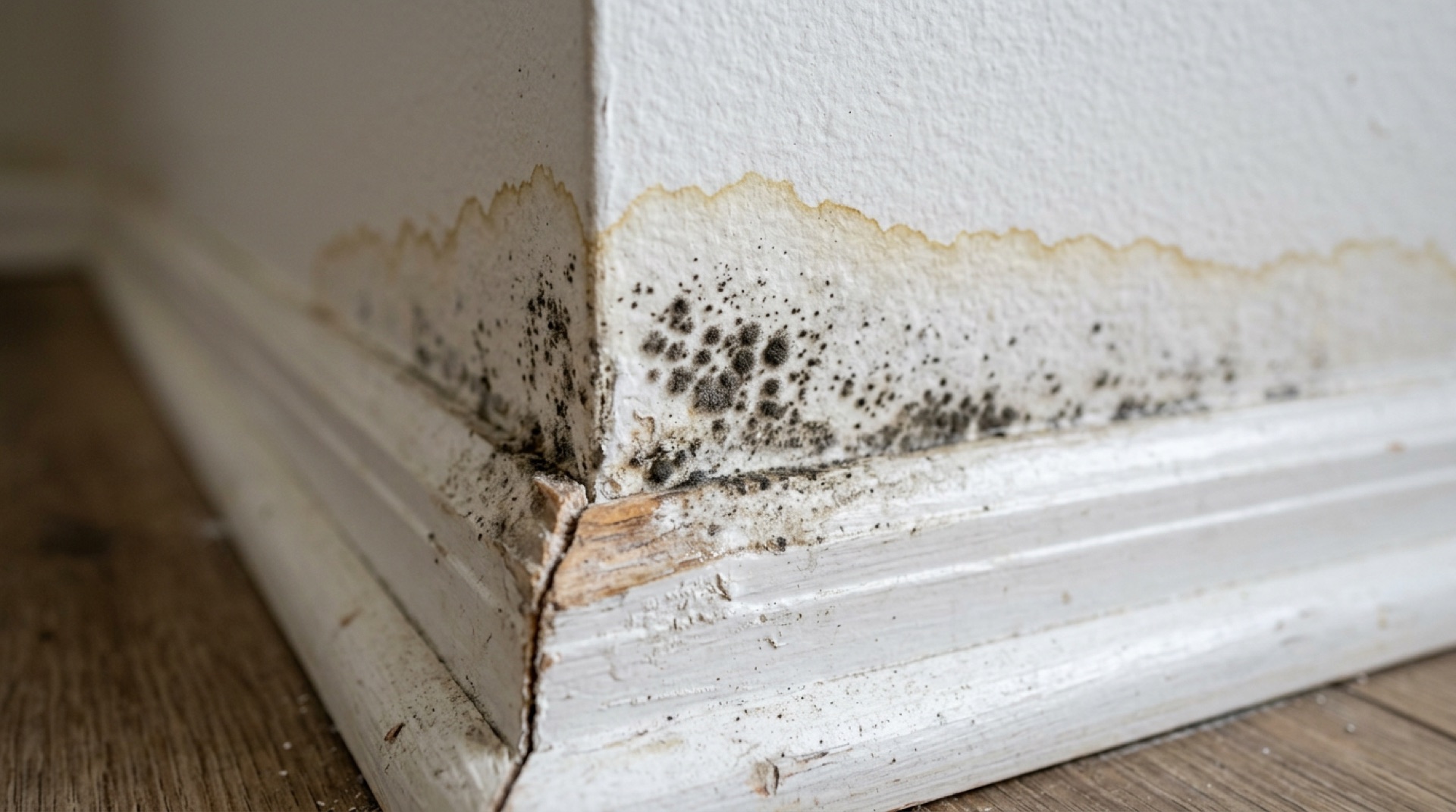
How quickly can mold start growing after water damage?
Mold can start growing within 24 to 48 hours after building materials get wet. The EPA advises homeowners to dry water-damaged areas and items within 24-48 hours to prevent mold growth, and says that in most cases mold will not grow if wet materials are dried in that window.
Mold spores are already present in nearly every home, floating in the air and settling in dust. They stay dormant until they find moisture and something to feed on, such as the paper face of drywall, wood framing, carpet backing or dust in a wall cavity. Water damage gives them both.
Early growth is usually invisible. By the time you see spots or smell a musty odor, mold may have been growing behind a baseboard or under carpet pad for days or weeks.
What does the mold growth timeline look like?
The timeline depends on how wet the material is, how warm the room is and how long the water stays. The table below shows the general pattern after a clean-water leak. It is a guide, not a guarantee in either direction.
Contaminated water, like a sewage backup, brings its own bacteria and organic material, so problems can start sooner and the cleanup is different.
| Time after water damage | What is usually happening | What to do |
|---|---|---|
| First few hours | Water spreads into carpet pad, drywall and under flooring | Stop the source and start extraction |
| 24 to 48 hours | Spores on wet materials can begin to grow, per EPA | Get drying equipment running |
| Several days | Growth may become visible on hidden surfaces and odor may start | Check behind baseboards and under pad |
| One to two weeks | Growth can spread across wet drywall, wood and insulation | Contain and remove affected materials |
| Weeks to months | Hidden mold can damage materials and keep returning | Professional remediation and fix the moisture source |
Does dry Las Vegas air stop mold?
No. Low outdoor humidity helps surfaces dry, but it does not reach water trapped inside walls, under flooring or in a concrete slab. Mold grows where the material is wet, not where the air is dry.
Closed rooms make it worse. A wet carpet in a closed bedroom raises the humidity in that room quickly, and the inside of a wall cavity can stay damp long after the painted face feels dry. Summer monsoon storms also bring short stretches of higher humidity to the valley.
The EPA recommends keeping indoor humidity below 60 percent, ideally between 30 and 50 percent. A small humidity meter from a hardware store can tell you where your home stands after a leak.
Where does mold hide after a leak?
Mold usually starts where water collects and air does not move. In Las Vegas homes, those spots are often low on walls and under floors, because most houses sit on a concrete slab.
Check these areas after any leak:
- Behind baseboards and at the bottom of drywall near the leak.
- Under carpet pad and along the tack strip at the edges of the room.
- Inside sink base cabinets, especially under kitchen and bathroom sinks.
- Behind and under the refrigerator, dishwasher and washing machine.
- Around the water heater closet and air handler.
- Ceilings below a roof leak or an upstairs bathroom.
Dealing with this right now? Get a free estimate.
Call 725-525-3122How do you stop mold before it starts?
Get water out and materials dry as fast as possible. Prevention costs far less than removal, and it starts in the first hours after a leak.
Steps that make the biggest difference:
- Stop the water at the fixture or main shutoff.
- Extract standing water from carpet and floors with professional equipment, not just towels.
- Pull wet items like rugs, boxes and cushions out of the area.
- Run dehumidifiers and air movers around the clock, not just during the day.
- Remove wet insulation or swollen baseboards that trap moisture.
- Confirm with a moisture meter that materials are dry before closing up walls or installing new flooring.
Which materials grow mold fastest?
Porous materials with organic content grow mold fastest, because they hold water and give mold something to eat. Hard, non-porous surfaces like tile, glass and metal can usually be cleaned and dried.
Materials that tend to be most at risk after a leak:
- Drywall, especially the paper facing on the back side inside the wall.
- Carpet pad and the jute or synthetic backing of carpet.
- Wood baseboards, door casings and the bottom plate of the wall framing.
- Particleboard and MDF in cabinets, which swell and hold water.
- Fiberglass and cellulose insulation, which trap dust and moisture together.
- Cardboard boxes, books and paper stored in closets and garages.
Can you clean mold yourself?
For a small patch, often yes. The EPA says that if the moldy area is less than about 10 square feet, roughly a 3 foot by 3 foot patch, most homeowners can handle the cleanup themselves using its guidelines.
For larger areas, mold after a lot of water damage, or mold caused by sewage or other contaminated water, the EPA recommends bringing in an experienced professional. The same goes for mold you suspect is in the HVAC system, since running it can spread spores through the house.
Do not paint or caulk over mold. Paint applied over moldy surfaces is likely to peel, and the growth continues underneath.
What does professional mold remediation involve?
Professional mold remediation contains the affected area, removes moldy materials that cannot be cleaned, cleans and treats what stays, and dries the structure so mold does not return. Fixing the moisture source is part of the job, because removing mold without fixing the water problem means it will likely come back.
Dark growth often worries people most. Learn how black mold removal is handled and why color alone does not tell you how risky a growth is.
If you just had a leak and want to avoid mold altogether, read how long water damage takes to dry. One Google reviewer, Jonathan Nicholson, wrote that JGW Group's "mold remediation and restoration were top-notch."
Frequently asked questions
Can mold grow in 24 hours after a leak?
It can start that quickly. The EPA says to dry water-damaged areas and items within 24 to 48 hours to prevent mold growth. Growth in the first day is usually microscopic, so you will not see it yet. The safest approach is to treat every leak as urgent and get water extracted and drying equipment running the same day.
Why does my house smell musty after a leak was fixed?
A musty smell after a repair usually means moisture is still trapped somewhere, such as inside a wall, under carpet pad or in the concrete slab, and mold or bacteria may be growing there. A moisture meter and a visual check behind baseboards can find the source. In Las Vegas, JGW Group offers free estimates to check for hidden moisture.
Does homeowners insurance cover mold?
It depends on your policy. Many policies limit or exclude mold, but may cover it when it results from a sudden, covered water loss like a burst pipe. Mold from a slow leak or long-term humidity is often excluded. Your insurer decides coverage, so check your policy and call your agent. Clear drying records help support any claim.
Is all black mold dangerous?
Color alone does not tell you which mold you have or how risky it is. Many molds look dark green or black. The EPA notes that mold exposure can irritate the eyes, skin, nose, throat and lungs, and can trigger asthma in people who are allergic. Any mold growth indoors should be cleaned up and its moisture source fixed.