
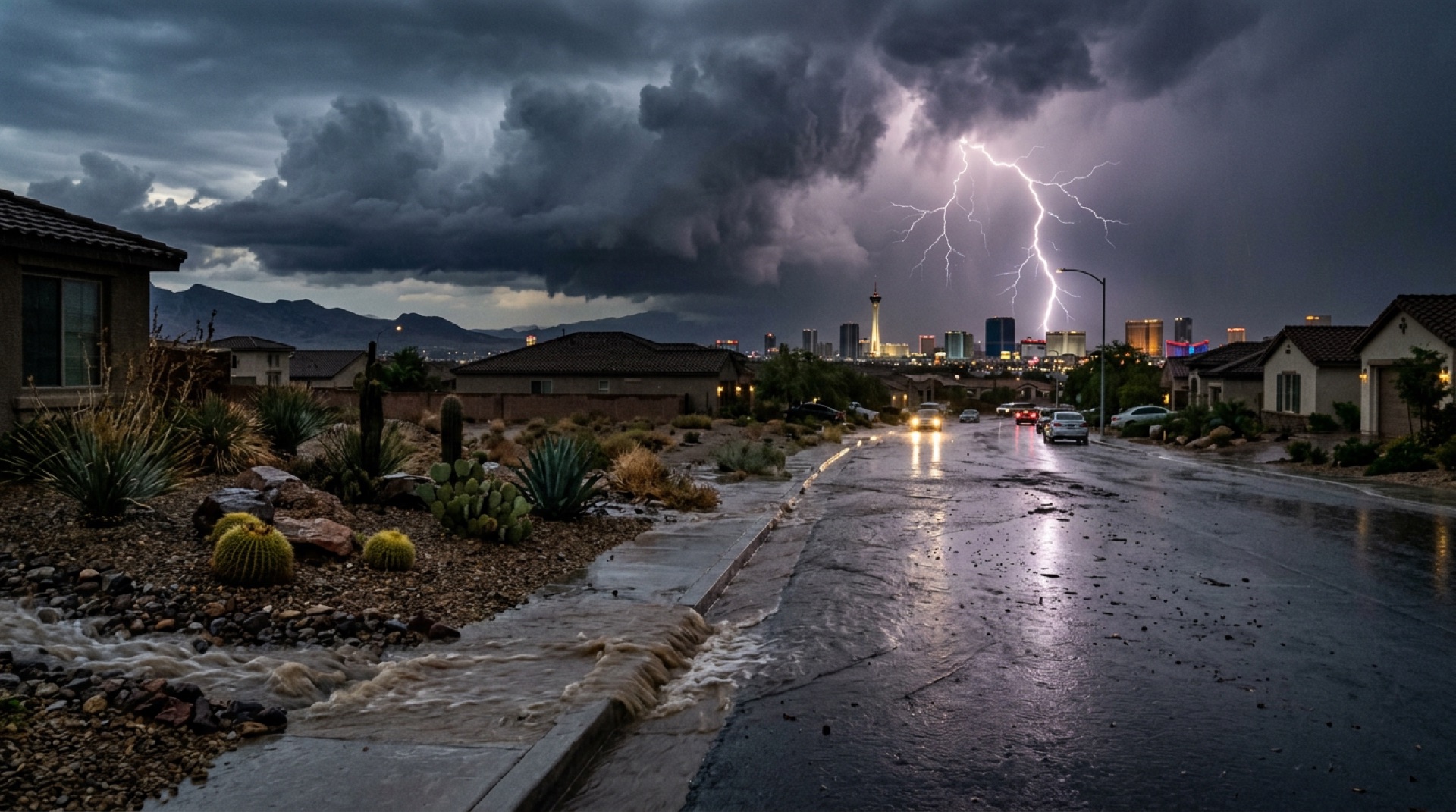
When is monsoon season in Las Vegas?
The National Weather Service defines monsoon season in the Southwest as June 15 through September 30. In the Las Vegas Valley, the storms tend to cluster in the middle of that window.
The NWS Las Vegas office notes in its Climate of Las Vegas summary that monsoon moisture typically moves into the Mojave Desert in July and August, raising humidity and triggering scattered thunderstorms, and that the monsoon usually wanes by September.
Most days stay dry. The risk comes from short, intense storms that drop a lot of rain on hard, dry ground that cannot soak it up fast enough.
Why do monsoon storms flood homes so quickly?
Desert soil, rooftops, streets and block walls shed water instead of absorbing it. A storm that would barely register in a wetter city can send runoff across yards, into garages and under doors in a few minutes.
The valley relies on a network of washes, channels and detention basins to move that water. The Clark County Regional Flood Control District plans and funds much of that system and publishes flood safety information for residents. Your own lot also matters: yard grading, drains and the slope of your driveway decide where water goes once it reaches your property.
How should you prepare your home before the season?
Spend an afternoon in late spring checking the places water enters a house. Small fixes now prevent most of the calls we see after a storm.
Use this checklist to work through the outside and inside of your home.
| Area | What to check | Why it matters |
|---|---|---|
| Roof and flashing | Cracked tiles, lifted shingles, gaps around vents and skylights | Wind-driven rain finds small openings |
| Gutters and scuppers | Leaves, dust and debris blocking flow | Clogged drains send water over walls and into eaves |
| Yard and gravel areas | Soil sloping toward the house, blocked yard drains | Water should run away from the foundation |
| Block wall weep holes | Holes blocked by gravel, soil or plants | Trapped water can pool against the house |
| Doors and windows | Worn weatherstripping, cracked caulk, failed sliding door tracks | Common entry points for wind-driven rain |
| Garage | Gap under the door, items stored on the floor | Runoff often enters here first |
| Paperwork | Policy declarations page, flood coverage, photos of rooms | Speeds up any claim after a storm |
Do you need flood insurance in Las Vegas?
It is worth asking your agent, because standard homeowners policies generally exclude flood. Surface water that flows into the house from the yard or street is usually treated as flood, not as a covered water leak.
Flood policies are sold through FEMA's National Flood Insurance Program and by private insurers. NFIP policies generally have a 30-day waiting period, so buy coverage well before the season, not when a storm is in the forecast. Homes near washes or in low spots on a street have the most to think about.
Dealing with this right now? Get a free estimate.
Call 725-525-3122What should you do during a monsoon storm?
Stay inside, stay off flooded roads, and keep an eye on where water is going around your house. Personal safety comes first. Property can be dried and repaired.
During a storm:
- Never drive or walk into flowing water. The NWS warns that 6 inches of moving water can knock a person down and about 2 feet can float most vehicles.
- Keep children and pets away from washes and storm drains, which fill fast.
- Move cars, rugs and stored items off the garage floor if water starts coming under the door.
- Use towels or sandbags at door thresholds if water is pooling against the house.
- Unplug electronics in rooms where water is entering, if you can do it safely without standing in water.
- Turn on weather alerts on your phone for flash flood warnings.
What should you do after storm water gets inside?
Treat storm water as contaminated and get it out quickly. Runoff picks up soil, fertilizer, animal waste and street debris before it reaches your floor, so it is not the same as water from a clean supply line.
Steps after a storm:
- Stay out of standing water if outlets or cords are submerged, and turn off power at the breaker only if you can reach it from a dry spot.
- Photograph the water line, damaged items and the entry point before cleanup.
- Call your insurer to report the damage and ask how it will be classified.
- Remove wet rugs, boxes and furniture from the area.
- Call a restoration company for extraction, cleaning and drying within the first day.
What should businesses and rental owners do?
Commercial properties and rentals need the same checks plus a plan for who responds when the owner is not there. A storm on a weekend night can flood a shop or an empty rental for hours before anyone sees it.
Before the season, owners and property managers can:
- Post the main water shutoff and electrical panel locations where staff or tenants can find them.
- Keep inventory, files and equipment off the floor in areas near doors and loading docks.
- Clear roof drains and scuppers on flat commercial roofs, which can pond quickly.
- Give tenants a 24/7 number to call when water comes in.
- Photograph the property before the season so you have a clear before-and-after record.
What should you check after a storm passes?
Walk the property the day after any heavy storm, even if no water came inside. Damage from wind-driven rain often shows up days later as a ceiling stain, a bubble in paint or a musty smell.
Look for wet insulation in the attic, stains around skylights and vents, water lines on garage walls, and gravel or soil washed against the house. Catching a small roof or window leak early keeps it from turning into ceiling damage or mold.
How is monsoon damage cleaned up and repaired?
Storm water cleanup starts with extraction, then cleaning and removal of porous materials that absorbed contaminated water, then drying with moisture monitoring. Carpet pad, the bottom of drywall and insulation are often removed after flood water.
JGW Group's flood damage cleanup team handles that work around the clock. Roof, window and wall damage from the same storm falls under storm damage restoration, and both can be handled by one team through reconstruction.
How contaminated the water is changes how it is cleaned. Learn the difference in Category 1, 2 and 3 water damage explained.
Frequently asked questions
Is monsoon rain water considered clean water?
Rain falling straight into a home through a roof opening may start out fairly clean, but water that flows across yards, streets or gravel picks up soil, debris and waste. The IICRC notes weather-related water is not automatically Category 3, so each loss is assessed on its source and contact. Runoff that enters from outside is usually handled as contaminated.
Does homeowners insurance cover monsoon flooding?
Usually not for flood water that enters from the ground, yard or street, which is excluded from standard homeowners policies. Damage from wind or a roof opening during the same storm may be handled differently. Flood coverage comes from a separate policy, often through FEMA's NFIP. Your insurer decides coverage, so review your policy before monsoon season.
How can I keep water out of my garage during a storm?
Check the weatherstrip at the bottom of the garage door, keep the driveway drain clear, and make sure the slope outside sends water away from the door. Keep stored items on shelves rather than the floor. During a heavy storm, sandbags or water barriers across the threshold can help. Never stand in water near outlets or cords.
Can JGW Group come out at night after a monsoon storm?
Yes. JGW Group answers emergency calls 24 hours a day, 7 days a week, including nights, weekends and holidays, across the Las Vegas area. Call 725-525-3122 to describe what happened. We will talk through safety steps on the phone and schedule an assessment with a free, no-obligation estimate.