
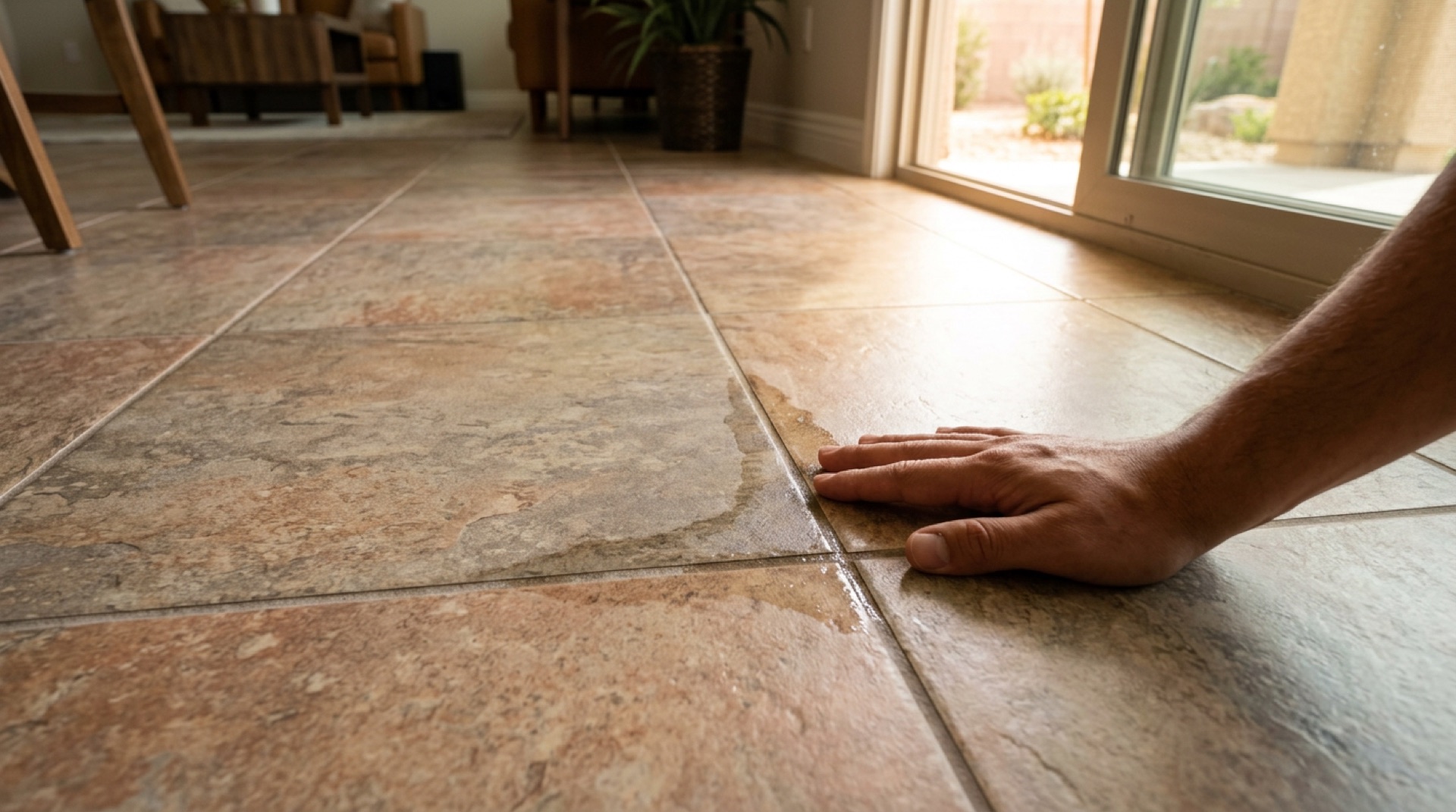
What is a slab leak?
A slab leak is a leak in a water or drain line that runs in or under your home's concrete foundation. Most Las Vegas homes are built slab-on-grade, so supply lines often run beneath or through the slab instead of in a crawlspace.
Because the pipe is buried, water can leak for weeks before you see anything. By the time a floor feels wet, water may have spread under tile, into carpet pad and up into the bottom of drywall.
What are the most common signs of a slab leak?
The most common signs are a warm floor, a high water bill, moisture with no visible source and the sound of water when nothing is running. Any one of these is worth checking. Two or more together are a strong reason to call a plumber.
Use this table to match what you notice with what it might mean.
| Sign | What it can mean | What to do |
|---|---|---|
| Warm or hot spot on tile or carpet | A hot water line leaking under the slab | Call a plumber for leak detection |
| Water bill jumps with no change in use | Water escaping somewhere on the property | Do the meter test below |
| Damp carpet or musty smell with no spill | Water wicking up through the slab | Pull back a corner and check the pad |
| Sound of running water with all fixtures off | Pressurized line leaking | Shut off fixtures and listen near floors |
| New cracks in tile or lifting wood floors | Moisture under flooring | Avoid walking on damaged areas |
| Water heater running constantly | Hot water line leaking | Check for warm floors near the heater path |
| Low water pressure throughout the house | Water lost before it reaches fixtures | Compare pressure at several taps |
How can you check for a leak with your water meter?
Your water meter is the simplest first test. The Las Vegas Valley Water District explains how to turn off all water and watch the flow-indicator triangle on your meter. If the triangle keeps moving, water is flowing somewhere.
The meter test tells you that you have a leak, not where it is. The district also explains how to narrow it down with your home's shutoff valve: if the triangle still moves with the shutoff closed, the leak is likely underground between the shutoff and the meter. If it stops, the leak is somewhere at or inside the house.
A leak inside the house could be a toilet flapper, an irrigation valve or a pipe under the slab. Pinpointing a slab leak takes a licensed plumber with acoustic or thermal leak detection equipment.
Why are slab leaks a concern in Las Vegas?
Slab foundations and long runs of buried pipe mean a leak in many valley homes has nowhere visible to show up. Water that would drip from a ceiling in a two-story house in another climate spreads quietly under tile and carpet here.
Concrete slabs also hold water once they are soaked. That means drying after a slab leak usually takes longer than drying after a leak upstairs, and it often requires lifting flooring so air can reach the concrete.
Dealing with this right now? Get a free estimate.
Call 725-525-3122Where does slab leak water show up first?
Slab leak water usually shows up first at the lowest, most absorbent spot near the leak. In a Las Vegas home that is often carpet pad, the tack strip along a wall, or the grout lines in tile.
Watch these areas closely if you suspect a leak:
- Carpet edges along exterior and interior walls, where the tack strip sits on bare concrete.
- Baseboards that swell, separate from the wall or show water stains near the floor.
- The bottom few inches of drywall, which can wick water upward and show bubbling paint.
- Grout lines that stay dark after mopping, or tiles that sound hollow when tapped.
- Closets and rooms that stay closed, where a musty smell builds without anyone noticing.
- Areas near the water heater, laundry room and kitchen, where hot and cold lines often run.
Is it a slab leak or something else?
Not every wet floor is a slab leak. A leaking toilet wax ring, a dripping water heater, a sweating air conditioning line or irrigation water pushing under a wall can all look similar at first.
A slab leak is more likely when the meter keeps moving with fixtures off, when the wet area is warm, or when moisture appears in the middle of a room away from any fixture. A plumber's leak detection confirms the source, and moisture mapping shows how far the water spread.
What should you do if you think you have a slab leak?
Confirm the leak, limit the water and get the pipe fixed, then get the area dried. The plumber fixes the pipe. A restoration company handles the water that already escaped.
Steps to take right away:
- Do the meter test and note whether the triangle moves.
- If water is visibly spreading, close the main shutoff until a plumber arrives.
- Take photos of warm spots, wet flooring and the meter for your records.
- Call your insurer to ask how your policy handles slab leaks before work starts.
- Call a licensed plumber for leak detection and repair.
- Call a restoration company to dry the slab, walls and flooring after the repair.
What happens after the pipe is fixed?
After the plumber repairs the line, the water that soaked into the slab, flooring and walls still has to come out. That is where slab leak water damage restoration comes in.
JGW Group maps moisture across the floor and walls, removes flooring or baseboards that trap water, and runs air movers and dehumidifiers while checking readings each day. When the slab and walls reach dry standard, the home is ready for new flooring and repairs. The same team can handle the rebuild, so you are not coordinating three separate companies.
If the leak also soaked cabinets or drywall, those are dried or replaced as part of full water damage restoration.
Will insurance pay for a slab leak?
It depends on your policy. Many policies help with tearing out and replacing the floor needed to reach the pipe and with the water damage the leak caused, while not paying for the pipe repair itself. Some limit coverage if the leak was slow and long-running.
Your insurer decides. Read our guide on whether homeowners insurance covers water damage in Nevada for the questions to ask your adjuster.
Frequently asked questions
How do I know if a warm floor is a slab leak?
A warm or hot spot on tile or carpet, especially along a path from the water heater, often means a hot water line is leaking under the slab. Check whether the spot stays warm when no hot water is running, then do the meter test. A licensed plumber can confirm the location with leak detection equipment before any floor is opened.
Can a slab leak cause mold?
Yes. Water from a slab leak can soak carpet pad, tack strip, baseboards and the bottom of drywall for weeks before anyone notices. That hidden moisture gives mold time to grow. Once the leak is fixed, drying the slab and walls fully and confirming it with moisture readings is the best way to keep mold from starting.
Does JGW Group fix the pipe?
The pipe repair is handled by a licensed plumber. JGW Group handles what comes after: extracting water, drying the slab, flooring and walls, documenting the damage for your insurer, and rebuilding what was removed. If you call us first, we can help you understand the next steps and schedule drying for right after the repair in Las Vegas.
How long does it take to dry a slab after a leak?
A soaked concrete slab often takes one to three weeks or more to dry, depending on how long it leaked, how thick the slab is and what flooring is on top. Lifting floor coverings and running dehumidifiers around the clock speeds the process. Daily moisture readings show when the slab is ready for new flooring.